How the Anion Gap Measures
The anion gap is a measure used to assess the equilibrium between measured electrolytes in the blood, especially sodium, chloride, and bicarbonate. An anion gap calculator helps doctors and patients determine whether there may be excess acids or other shifts affecting the body’s acid-base balance. It is not a literal count of a single substance. Instead, it shows the difference between positively charged and negative ions that are routinely reported on a basic metabolic panel or a blood gas.
The classic concept is simple: serum sodium is compared with serum chloride and serum bicarbonate to estimate the amount of unmeasured anions in the bloodstream. Because some important ions are not routinely included in standard lab panels, the anion gap functions as a screening tool for hidden abnormalities. This makes it especially useful for identifying causes of metabolic acidosis and related electrolyte imbalance patterns.
Although many calculators present a single result, the value should always be interpreted in context. The same number can mean different things depending on the patient’s serum level of albumin, the presence of kidney dysfunction, and whether the blood sample was collected from a comprehensive chemistry panel or a blood gas analysis. Understanding the physiology behind the number is what gives the result its clinical significance.
Why Reduced Albumin Affects the Result
Albumin is one of the most plentiful proteins in blood and is a major negatively charged molecule. When hypoalbuminemia is present in the blood, fewer negative charges are available in the bloodstream, which can make the measured anion gap seem lower than it truly is. This is why low albumin can obscure an otherwise abnormal result and distort the evaluation of acid-base balance.
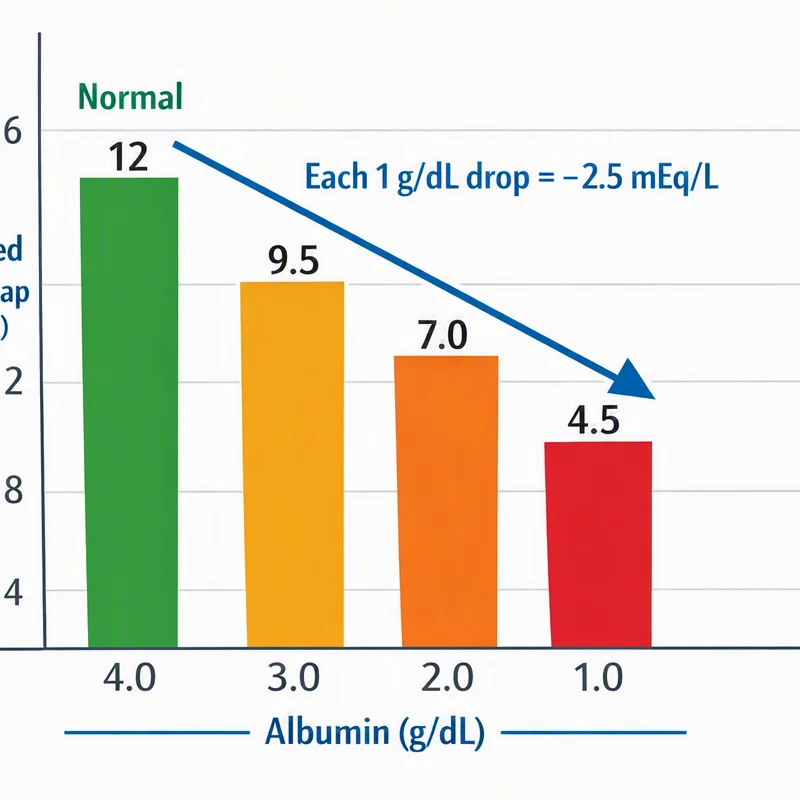
Albumin is one of the main unmeasured anions. If albumin concentration drops, the gap between measured cations and measured anions shrinks. That means a patient with serious acid buildup may still show a “normal” or even low anion gap if albumin is not accounted for. For this reason, the raw value should not be used alone when albumin is decreased.
This has clinical significance because a low albumin serum level often occurs in hospitalized or medically complex patients, including those with inflammation, liver dysfunction, poor nutrition, or kidney disease. In those settings, the anion gap is still useful, but only after an appropriate adjustment. Without that step, interpretation may miss high anion gap metabolic acidosis or underestimate the severity of an underlying disorder.
How to Calculate the Albumin-Corrected Anion Gap
An anion gap calculator can approximate the initial result from the measured electrolytes, then apply a correction formula to account for low albumin. The most common approach uses the serum concentrations of sodium, chloride, and bicarbonate, then adjusts for the albumin concentration. Some clinicians also consider potassium, although many modern formulas omit kidney failure impact on anion gap it because its contribution is relatively small and inconsistent across settings.
A common uncorrected formula is:
Anion gap = serum sodium − (serum chloride + serum bicarbonate)
When albumin is low, a correction is used to determine the albumin-corrected anion gap. One widely used adjustment adds approximately 2.5 mEq/L to the measured gap for every 1 g/dL decrease in serum albumin below a normal baseline of about 4.0 g/dL. The exact correction factor may vary by institution and calculator, which is why the reference range should always be checked.
Example conceptually:
- Measured sodium, chloride, and bicarbonate give an anion gap result. Albumin is lower than expected, indicating hypoalbuminemia. The gap is then adjusted upward using the correction formula. The corrected value is checked with the relevant reference range.
This adjustment improves diagnostic screening because low albumin can hide elevated acid burden. In practice, clinicians use the corrected number to interpret whether the result suggests a normal state, a concealed acidosis, or another abnormal physiology pattern. The corrected value can also help distinguish a benign measurement from one that signals a serious disorder requiring attention.
Clinical takeaway: when albumin is decreased, the raw anion gap may look deceptively normal. The corrected value is often more meaningful for diagnosis and evaluation.
When the Revised Anion Gap Is Elevated
A high anion gap after correction typically suggests that there are additional acids in the blood. This is the classic pattern for high anion gap metabolic acidosis, which can occur when the body produces excess acid, loses buffering capacity, or cannot clear acids effectively. The corrected result is especially important because low albumin can otherwise hide the abnormality.
Two common causes are lactate buildup and ketone buildup. Lactic acidosis may develop when tissues are not getting enough oxygen or when metabolism is severely stressed. Ketoacidosis can occur in diabetes, starvation, or alcohol-related states, where ketones accumulate and drive the gap upward. In both situations, the albumin-corrected anion gap may reveal a problem that the uncorrected number understates.
Another important cause is renal insufficiency. When the kidneys cannot excrete acids effectively, unmeasured acids build up, increasing the gap. Toxin exposures, severe illness, and other metabolic disturbances can also contribute. The point is not to diagnose from the number alone, but to use the result as a clue that guides further evaluation.
Clinicians often look at the corrected anion gap alongside the blood pH, bicarbonate, and other tests to determine whether the patient has an acid load that requires immediate treatment. If the corrected value is elevated, the clinical significance is much greater than a borderline uncorrected number would suggest.
When the Anion Gap Appears Normal or Low
A within-range anion gap does not always mean that acid-base status is truly normal. In some cases, reduced albumin can hide a subtle disorder, making the result look reassuring even when a concerning process is present. This is why the corrected measurement matters so much in patients with hypoalbuminemia.
A true low anion gap is less common than a high one. It can be caused by low albumin, specific paraproteins, or measurement issues in the lab. Before assuming a disease process, clinicians often first consider lab error because sample handling, analyzer differences, or measurement problems can produce misleading results. Repeating the test may be the most straightforward and most practical next step.
Another reason the gap can seem reduced or normal is hyperchloremia. If chloride rises relative to sodium and bicarbonate, the difference decreases. This may occur with normal gap acidosis, volume expansion, or compensatory changes in the body. A normal anion gap metabolic acidosis can still be present even when the total gap appears unchanged, which is why bicarbonate and chloride trends matter.
In short, a smaller or normal result does not automatically rule out disease. The clinical interpretation should consider albumin, the measured electrolytes, and whether the patient has an underlying electrolyte imbalance or acid-base disorder. The calculator is a support tool, not a standalone diagnosis.
Main Causes of Reduced Albumin
Since albumin correction is highly important, recognizing why albumin is low helps explain the result. Malnutrition is one common cause. Insufficient protein intake or poor absorption can reduce albumin synthesis over time, lowering the serum level and changing the measured anion gap.
Liver disease is a further major cause because the liver produces albumin. When liver function declines, albumin production falls and the blood concentration may decrease. This can affect the calculation and may also reflect more severe illness.
Nephrotic syndrome can lower albumin through urinary protein loss. The kidneys leak protein into the urine, leading to hypoalbuminemia and potentially significant edema. In this situation, the gap may be falsely low unless corrected.
Inflammation is also a regular contributor. During short- or long-term inflammatory states, albumin often decreases as part of the body’s stress response. This drop may not reflect nutrition alone; it can signal systemic illness and altered physiology. Because of that, the corrected anion gap can be particularly useful in sick patients where multiple processes are happening at once.
How Clinicians Read the Result
Doctors infrequently use the number in isolation. Instead, they evaluate the anion gap with the patient’s presentation, the basic metabolic panel, and sometimes a blood gas. This more comprehensive comparison helps determine whether the result fits metabolic acidosis, whether compensation is occurring, and whether the abnormality is likely to be important clinically.
For instance, a patient with low albumin and a borderline anion gap on the metabolic panel may still have considerable acid accumulation once the correction is applied. If the blood gas also shows low pH and low bicarbonate, the interpretation becomes more urgent. The combination of measurements provides more robust evidence than any single test.
The clinical interpretation also depends on whether the result fits an overall electrolyte disorder. Potassium may be elevated or decreased, chloride may be abnormal, and bicarbonate may be reduced. These patterns help identify whether the problem is due to acid buildup, loss of base, kidney dysfunction, or some other cause.
In practice, the anion gap is a screening and evaluation tool that supports diagnosis. It can suggest the need for more testing, help track trends over time, and clarify whether a patient’s current treatment is working. A corrected result is particularly valuable when albumin is low because it improves the reliability of the comparison.
Limitations of Anion Gap Calculators
Although a carefully built calculator has drawbacks. The reference range changes by laboratory because multiple analyzers and methods can alter the expected result. A value that looks abnormal in one setting may be acceptable in another. That is why the exact lab-specific range should always guide interpretation.
The correction factor is another challenge. Different formulas exist, and not all are perfectly aligned with every patient population. Some formulas may overshoot or correct too little depending on the clinical context. The choice of formula affects the final corrected result, so the number should be viewed as an approximation rather than an absolute truth.
There are also issues with accuracy. If the underlying electrolytes are inaccurate, the calculated gap will also be inaccurate. Sample contamination, delayed processing, and analyzer differences can all influence the output. When the result does not match the clinical picture, redoing the test or verifying it with a blood gas may be appropriate.
Finally, there are diagnostic limitations. The anion gap cannot tell you the cause of the problem by itself. It cannot distinguish lactic acidosis from ketoacidosis or renal failure without additional assessment. It also may not identify every acid-base disorder, especially when multiple conditions coexist. The calculator is best used as part of a larger evaluation rather than as a single decisive answer.
FAQs
How do you calculate the anion gap when albumin is low?
Begin by calculate the standard anion gap using sodium, chloride, and bicarbonate. Then apply an albumin correction so the result reflects the lower serum albumin. This adjustment helps you interpret the gap more accurately because hypoalbuminemia can make the measured value appear falsely low or normal.
Why does low albumin lower the anion gap?
Albumin is a key negatively charged protein and one of the main unmeasured anions. anion gap in chronic kidney disease When albumin decreases, there are fewer negative charges in the blood, so the measured anion gap drops. This change can hide an underlying acid-base problem if the result is not corrected.
What is the adjusted anion gap calculation?
A typical adjustment increases about 2.5 mEq/L to the measured anion gap for each 1 g/dL that albumin is below 4.0 g/dL. The exact formula may vary depending on the tool or lab. Always review the corrected value with the correct reference range used in your context.
Can a typical anion gap still mask metabolic acidosis?
Yes. A normal anion gap can still occur in the presence of metabolic acidosis, especially if albumin is low or if the patient has normal anion gap metabolic acidosis. It is important to review bicarbonate, chloride, blood gas results, and albumin so that a masked increased-gap disorder is not missed.
When should a low anion gap be reassessed or investigated?
A low anion gap should be reassessed if it does not fit the clinical picture, if lab error is possible, or if the patient has hypoalbuminemia or another suspected electrolyte imbalance. If the value continues to be abnormal, clinicians may look into albumin, total protein, kidney function, and other causes. This is general information only and does not take the place of medical advice or a personal evaluation by a qualified clinician.